
Rabies is a serious viral disease that can affect the brain and nervous system. The good news is that rabies can be prevented when the right steps are taken promptly after a possible exposure.
A playful moment with a dog. A child trying to feed a cat. A small scratch while playing with an animal.
Sometimes, we may look at such incidents and think, “It is only a small wound. Nothing will happen.”
But when it comes to rabies, ignoring a bite or scratch can be dangerous.
Rabies is one of those diseases where a simple action taken immediately after exposure can make the difference between life and death.
In this article, we will understand:
- What is rabies?
- How does it spread?
- Why is it so dangerous?
- Can rabies be cured?
- What should you do immediately after an animal bite or scratch?
- Is a dog the only animal that can transmit rabies?
- What should parents teach their children?
What is rabies?
Rabies is a viral disease that affects the central nervous system, including the brain and spinal cord.
An infected mammal usually transmits the virus through its saliva, most commonly through a bite. Certain scratches can also be an exposure, particularly when saliva contaminates the wound.
The dangerous part is that the virus does not simply remain at the place where the animal has bitten or scratched.
It can gradually move through the nervous system towards the brain and spinal cord.
And this is where rabies becomes extremely serious.
Why is rabies so dangerous?
The most important thing to remember is this:
Rabies can be prevented after an exposure, but once clinical symptoms appear, the disease is almost invariably fatal.
This is why waiting for symptoms is not a safe approach.
A person should not wait to see whether they develop fever, unusual behaviour, difficulty swallowing, fear of water, or other symptoms before seeking medical care.
The treatment that prevents rabies after an exposure is called post-exposure prophylaxis (PEP).
Prompt and appropriate PEP can prevent the virus from establishing infection in the nervous system. It includes proper wound care, rabies vaccination and, for certain severe exposures, rabies immunoglobulin or another recommended rabies antibody treatment.
Is a dog the only animal that can cause rabies?
No.
This is an important misconception to clear up.
Dogs are the main source of human rabies transmission globally, accounting for the vast majority of human cases. But rabies can infect other mammals as well. Cats and wild animals can also transmit the virus.
Therefore, the important question is not simply:
“Was it a dog?”
The important question is:
“Was there a possible rabies exposure, and does this person need medical assessment?”
If you are bitten or scratched by an unfamiliar or potentially rabid animal, seek medical advice promptly rather than trying to judge the risk yourself.
What should you do after an animal bite or scratch?
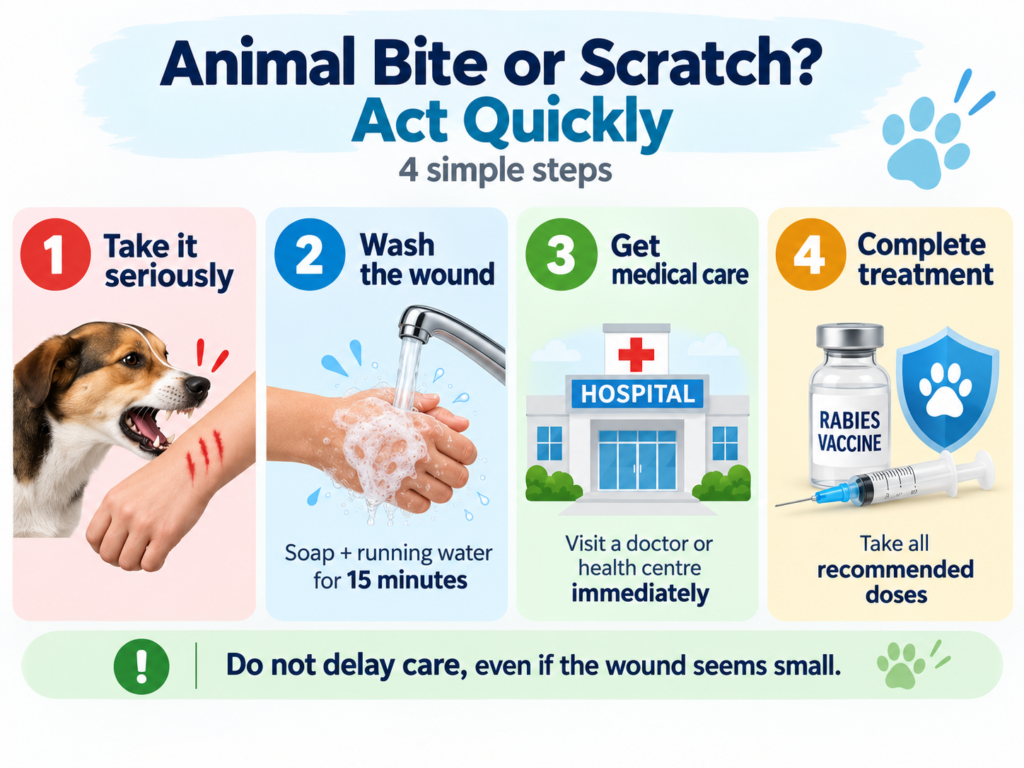
This is perhaps the most important part of the entire article.
Step 1: Wash the wound immediately
Wash and flush the wound thoroughly with soap and running water for about 15 minutes.
Do not just wipe the wound and move on.
Thorough washing helps remove and inactivate virus that may still be present around the wound.
Step 2: Use an appropriate antiseptic if available
After thorough washing, an iodine-containing or other appropriate virucidal preparation may be used according to medical guidance.
Avoid applying irritants or traditional substances such as chilli powder, acids or plant juices to the wound.
Step 3: Go to a healthcare facility as soon as possible
Do not assume that a small wound means there is no risk.
A healthcare professional can assess:
- The type of animal
- Whether the skin was broken
- Whether there was a bite or scratch
- Whether saliva could have contacted the wound
- The location and severity of the exposure
- Your previous rabies vaccination history
Based on this assessment, the healthcare professional can decide whether you need rabies PEP.
Step 4: Take the recommended rabies treatment
Depending on the type of exposure, PEP may include rabies vaccination and, for certain severe exposures, rabies immunoglobulin or another recommended antibody treatment.
The vaccination schedule is not the same for everyone. It can depend on the vaccine used, how it is given, previous vaccination and other medical factors.
So, rather than following a schedule found randomly on the internet, follow the schedule given by the treating healthcare professional.
For detailed guidance on rabies prevention and post-exposure treatment in India, you can refer to the National Guidelines for Rabies Prophylaxis issued by the National Centre for Disease Control (NCDC).
What about a small scratch?
This is where people sometimes make a mistake.
They may think:
“There was no major bleeding, so there is no danger.”
But the size of the wound alone does not determine whether rabies PEP is needed.
WHO considers minor scratches or abrasions without bleeding a possible rabies exposure. If the animal may carry rabies, wound washing and vaccination may be required. Deeper scratches or bites that penetrate the skin can require vaccination plus rabies immunoglobulin or another recommended antibody treatment.
So, don’t make your own risk assessment based only on how small the wound looks.
Get it medically assessed.
Why can’t we simply wait for symptoms and then take medicine?
This is an important question.
Rabies is different from many common infections.
After entering the body, the virus can move through the nervous system and eventually reach the central nervous system. Once clinical disease develops, the brain and spinal cord are affected, and the disease is almost invariably fatal.
The blood-brain barrier also makes treatment of infections involving the brain more complicated. But it would be inaccurate to say that “medicines cannot enter the brain.”
The key point is much simpler:
There is no reliably effective treatment that we can depend on once clinical rabies has developed.
That is why rabies prevention is focused on stopping the virus before it reaches the central nervous system.
And that is exactly why immediate wound washing and appropriate PEP are so important.
Parents: Please teach children this
Children are particularly important when we talk about rabies prevention.
A child may see a friendly-looking dog or cat and immediately want to touch, hug or feed it.
The animal may even appear calm.
But children may not understand that an animal can unexpectedly bite or scratch when it feels frightened, threatened or disturbed.
Parents can teach children a few simple rules:
1. Do not approach unfamiliar animals.
2. Do not try to touch or feed an animal without adult supervision.
3. Never disturb an animal while it is eating, sleeping or caring for its young.
4. Avoid teasing, chasing or pulling an animal’s tail or ears.
5. If an animal bites or scratches you, tell an adult immediately.
And most importantly:
Never hide an animal bite or scratch from your parents because you are afraid of being scolded.
A child may think, “It is only a small scratch.”
Parents need to make sure children know that even a small exposure should be reported immediately.
What if the animal looks healthy?
This is another situation where people may become overconfident.
Someone might say:
“The dog looks perfectly healthy, so there is no problem.”
Do not make that decision yourself.
Rabies remains a public-health concern in India. National guidance recommends prompt treatment after a suspected exposure. For dogs and cats, healthcare professionals may sometimes use a 10-day observation period as part of their assessment. However, this does not mean you should wait at home before seeking medical advice.
The most important message
Rabies is frightening because once clinical symptoms appear, it is almost always fatal.
But there is another side to the story:
Rabies is preventable.
A person who has been exposed does not need to sit at home and wait for symptoms.
Immediate wound washing and timely medical assessment for appropriate PEP can prevent the disease from developing.
So remember these three things:
Wash. Report. Get medical care.
If you or your child has been bitten or scratched by an animal that could potentially carry rabies, wash the wound thoroughly with soap and water for about 15 minutes and seek medical care promptly.
Don’t wait for symptoms.
A small-looking wound does not automatically mean there is no risk.
Similarly, a friendly or healthy-looking animal should not be used to judge the risk on your own.
When it comes to rabies, taking precautions early is far safer than regretting a delay later.
A final reminder
This article is intended for general awareness and does not replace medical advice. A qualified healthcare professional should assess any possible rabies exposure. They can decide whether you need post-exposure prophylaxis and which treatment is appropriate.